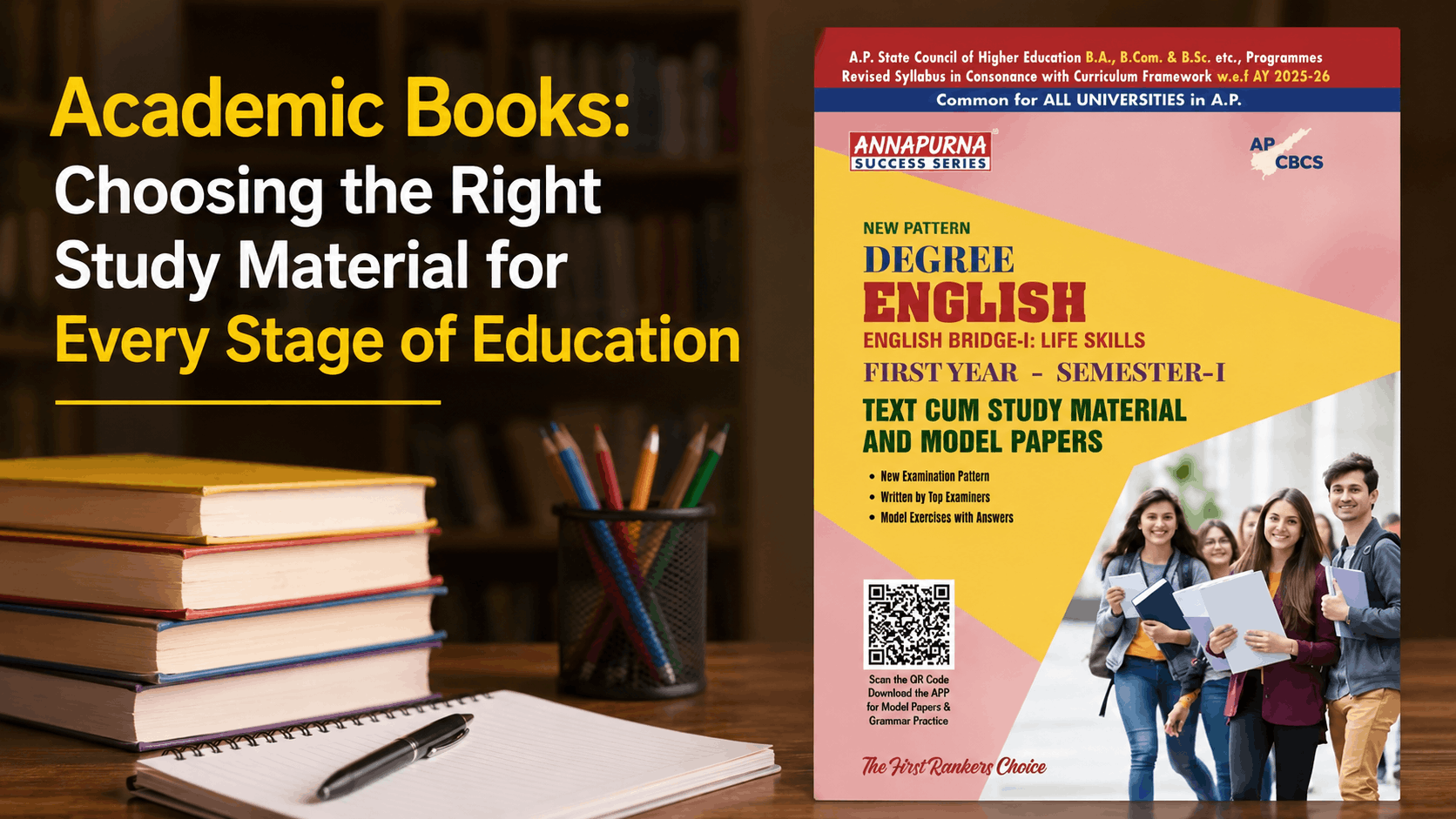
Good academic preparation starts with understanding the subject, following the syllabus, and using study resources that support consistent learning.
For students, Academic Books remain an important part of this process. A well-structured book can explain concepts in an organized way, provide examples, support revision, and help students prepare for examinations.
However, students at different educational levels have different requirements. An intermediate student may need syllabus-focused preparation, while an undergraduate student may require semester-specific textbooks and model papers. Entrance-exam aspirants may need dedicated preparation material that combines concepts with extensive practice.
Annapurna Publishers has built its catalogue around different stages of learning, with 600+ titles covering intermediate, UG, PG, and competitive examinations.
1. What Are Academic Books?
Academic books are educational resources created to support learning in a particular subject, course or educational programme.
They can include:
- Textbooks
- Subject-specific books
- Study material
- Reference books
- Semester books
- Model papers
- Practice resources
- Examination preparation books
The right academic book depends on the student’s level of education, syllabus, subject and learning objectives.
For example, AP Books currently lists academic resources for UG students, including first-year English and Telugu semester books and material containing model papers and study resources.
2. Why Academic Books Matter for Student Learning
Academic books provide students with a structured way to study a subject.
Instead of relying on scattered information from different sources, students can use a syllabus-aligned resource to work through concepts systematically.
A useful academic book can help students:
- Build subject knowledge
- Understand difficult concepts
- Follow a structured learning sequence
- Revise important topics
- Practise examination questions
- Prepare for semester examinations
- Strengthen fundamentals
Books are especially useful when combined with classroom teaching, practical learning, revision and question-solving.
3. Academic Books for Different Stages of Education

Students should not select academic books based only on popularity. The educational level matters.
Intermediate Students
Intermediate-level students often need resources that closely follow their syllabus and help them prepare for board or entrance examinations.
The material should provide clear explanations and sufficient opportunities for revision and practice.
Undergraduate Students
UG students usually study according to university and semester-specific curricula.
Academic books therefore need to match the relevant course, subject and semester.
AP Books currently lists UG books for Telangana and Andhra Pradesh, including first-year English and Telugu semester resources.
Postgraduate Students
PG students generally require more specialised resources related to their course and subject.
The choice should therefore be based on the specific programme, university syllabus and academic requirements.
Annapurna Publishers states that its broader catalogue includes resources for PG students alongside Intermediate, UG and competitive examination learners.
4. Choosing Academic Books Based on Your Syllabus
The syllabus should be the starting point when choosing an academic book.
Before buying a book, students should check:
- Course or class
- Subject
- University or education board
- Semester
- Current syllabus
- Language or medium
- Examination requirements
- Availability of model papers or practice material
This is particularly important for university students because course structures and syllabi can differ between institutions.
For example, AP Books lists a Degree First Year Telugu Semester-I resource specifically for first-year students in Andhra Pradesh universities, with model papers and study material.
5. The Role of Model Papers and Study Material
Academic books do not have to be limited to theoretical explanations.
Model papers and additional study material can help students move from learning concepts to applying them.
Practice resources can help students:
- Test their understanding
- Identify weak areas
- Practise writing answers
- Improve time management
- Become familiar with question formats
- Prepare for semester examinations
AP Books currently offers academic products that combine subject material with model papers and study material, including its Degree First Year Telugu resources.
6. Academic Books for Entrance Exam Preparation

Academic learning and entrance-exam preparation often overlap, particularly for students preparing for competitive entrance tests after Intermediate.
In addition to its Academic Books category, AP Books has separate categories for engineering entrance, medical entrance and other entrance examinations.
The website currently features preparation material for examinations such as JEE and NEET, including an all-in-one JEE Main classroom study material covering Mathematics, Physics and Chemistry, and NEET classroom study material covering Biology, Physics and Chemistry.
For entrance preparation, students should look for resources that combine conceptual understanding with sufficient practice.
7. Academic Books and Digital Learning
Digital learning has changed how students access educational information, but physical academic books continue to provide an organised learning experience.
Students today can combine:
- Printed textbooks
- Digital resources
- Online lectures
- Practice tests
- Notes
- Educational videos
The important consideration is not whether one format is universally better than another. It is whether the resource helps the student understand the subject and prepare effectively.
A well-structured academic book can remain a useful foundation while digital resources provide additional explanations and practice.
8. Why Choose Annapurna Publishers for Academic Books?
Annapurna Publishers describes itself as an academic publishing and printing institution with 35+ years of experience and a catalogue of more than 600 titles. Its resources cover Intermediate, UG, PG and competitive examination requirements.
Its current Academic Books category includes UG resources such as English and Telugu semester books, while other parts of the website provide dedicated entrance-exam preparation material. The publisher also states that its distribution network reaches 200+ bookstores across Andhra Pradesh and Telangana.
For students, the most important consideration remains the suitability of the resource: the book should match the syllabus, educational level, subject and preparation objective.
Frequently Asked Questions
What Are Academic Books?
Academic books are educational resources created to support structured learning in a particular subject, course, class, semester, or educational level. They can include textbooks, subject-specific books, reference books, study material, model papers, question banks, and examination-focused resources.
The type of academic book a student needs depends on their educational level and learning objective. For example, a school or intermediate student may need syllabus-focused textbooks and preparation material, while an undergraduate student may require books aligned with a particular university, course, subject, and semester.
When selecting an academic book, students should make sure that its content is relevant to their current syllabus and provides the level of explanation and practice they need.
Why Are Academic Books Important for Students?
Academic books provide students with structured and organised information that can make learning and revision more systematic. Instead of studying from scattered sources, students can use a subject-focused book to work through concepts in a logical sequence.
A good academic book can help students:
- Understand fundamental and advanced concepts
- Study topics according to their syllabus
- Refer back to difficult subjects during revision
- Make notes from organised study material
- Practise questions related to the subject
- Prepare for semester, board, university, or other examinations
- Strengthen their understanding before moving to advanced topics
How Do I Choose the Right Academic Book?
Choosing the right academic book depends on more than the subject name. Students should first identify their course, educational level, syllabus and examination requirements.
Before purchasing a book, consider:
- Course or class: Check whether the book is intended for your level of education.
- Subject: Make sure it covers the specific subject you are studying.
- Syllabus: Verify that the contents correspond with the current syllabus.
- University or board: For college and university students, check whether the book is relevant to the applicable university or curriculum.
- Semester: UG students should confirm that the book corresponds to the required semester.
- Language or medium: Select a language in which you can understand and revise the material comfortably.
- Practice material: If examination preparation is important, check whether the book includes model papers, questions or other practice resources.
Are Academic Books Available Online?
Yes. Students can browse and purchase academic books online through the AP Books website. The online catalogue includes academic resources covering different educational requirements and categories.
Online access can make it easier for students to search for books by category, subject, course or educational level before making a purchase.
Students should still check the book title, edition, syllabus relevance, subject and course details before ordering to ensure that the selected resource matches their academic requirements.
Does Annapurna Publishers Offer UG Books?
Yes. AP Books lists UG/degree-level academic books for students, including resources for Andhra Pradesh and Telangana.
The catalogue includes first-year semester resources in subjects such as English and Telugu, along with books that may include model papers and study material.
UG students should select books according to their degree programme, subject, year, semester and applicable university syllabus. Checking these details before purchasing is particularly important because academic requirements can vary between courses and universities.
Are Academic Books Available in Telugu?
Yes. AP Books offers Telugu-medium academic and examination-related resources in addition to English-language material.
For example, its catalogue includes Degree First Year Telugu Semester-I material with model papers and study material. Telugu-medium resources can be useful for students who prefer studying and revising academic concepts in Telugu.
Can Academic Books Help With Entrance Examination Preparation?
Academic books can help students build the subject knowledge and fundamental concepts needed for further examination preparation. However, students preparing specifically for an entrance examination should also consider dedicated entrance-exam books and study material designed around the relevant examination pattern and syllabus.
AP Books maintains separate entrance-examination categories, including resources for engineering and medical entrance preparation, with JEE and NEET-related study material available through its catalogue.
Should Students Use Multiple Academic Books for the Same Subject?
Not necessarily. Using several books for the same subject does not automatically result in better preparation. In many cases, students can benefit more from thoroughly understanding one reliable, syllabus-relevant primary resource and then using supplementary material when there is a specific need.
Additional books can be useful when a student:
- Needs a different explanation of a difficult concept
- Requires additional practice questions
- Wants model papers or question banks
- Needs a dedicated revision resource
- Is preparing for a specific examination
What Is the Difference Between an Academic Book and a Reference Book?
An academic book is generally used as part of structured learning for a particular subject, course or educational programme. A reference book is typically used to obtain additional information, explanations or deeper coverage of specific topics.
The choice between the two depends on the student’s purpose. For syllabus-based examination preparation, the primary academic resource should generally match the course and syllabus first.
How Can Students Use Academic Books Effectively?
Students can get more value from academic books by following a consistent study process rather than simply reading chapters repeatedly.
A practical approach is to:
Understand the syllabus → Study the topic → Make notes → Practise questions → Review mistakes → Revise
Students should identify important or difficult topics while studying and revisit them during revision. Where the book includes model papers or practice questions, these can be used to test understanding and improve examination readiness.
What Should Students Check Before Buying Academic Books Online?
Before purchasing an academic book online, students should check the title, subject, course, year, semester, syllabus, language and examination relevance.
For university-level books, it is particularly important to verify whether the resource is intended for the correct university, course and semester. Students should also check whether the book includes additional material such as model papers, practice questions or study material if these are required.
Taking a few minutes to verify these details can help students select a resource that is appropriate for their actual academic requirements.

No comments yet. Be the first!